Reading River Current From the Bank
A familiar stretch of shoreline can reveal where water slows, accelerates, and changes direction - if you know what to look for.
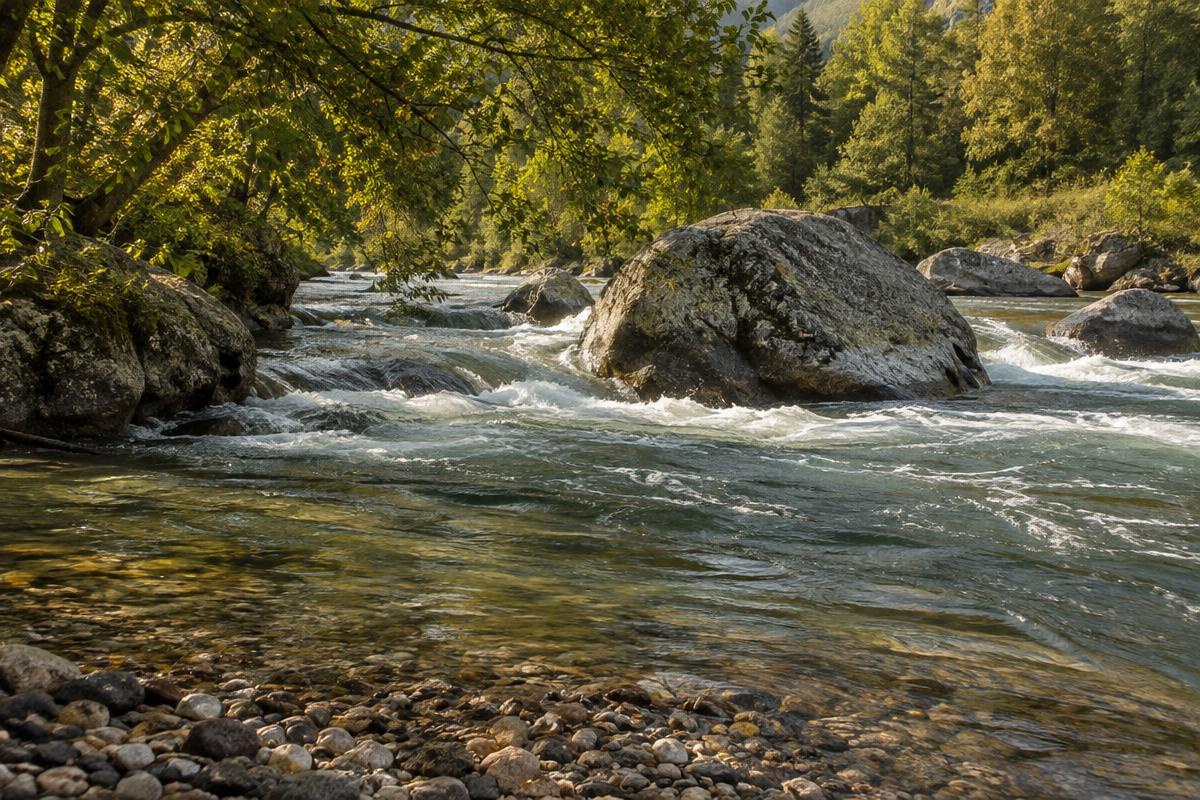
Fast river current breaking around granite boulders with overhanging trees
Getting started
Use the same county access for practical examples of how you would read visible water movement and compare bank, cover and channel for a familiar stretch of shoreline that has been affected by a storm or a season of high water. This is a pretty simple stretch of water that can look very different at different times of the year. It is often easy to read the water from the bank of a river, to identify the fast water, slow water and pools and to get some idea of the depth of the water as well as the shape of the channel.
Start With the Lines on the Surface
In the clearest of cases, a seam is a narrow band of water of different speed to the surrounding areas. It will be moving quickly down one side of the seam and slowly down the other. If the seam is holding in the same place then it is worth a close inspection, especially if it is running along the edge of a point of gravel, a submerged bar, a bridge support or a sharp bend in the channel.
Smooth surface areas can be indicators of deep water, slow current or areas of “shadow” that form from other features such as shallow points or cover. Repeated ripples on a patch of water can indicate a rocky bottom, a shallow shelf or fast water crossing over a channel feature. Glassy surface and broken surface close together should be observed in more detail.
Find the Quiet Water Beside the Push
An eddy will form at an obstruction or at the inside of a bend in the river. This area can form behind a midstream log, at the base of a cut bank, or below a large rock in the river. Leaves will be circling in the eddy, as well as having foam drift up stream along its edge. The water in an eddy will appear to be rotating.
Their boundaries are more obvious than the calm water within them. A log in the stream creates eddies behind it. Cut banks in the stream banks create seams at the base of them. Large rocks create seams on the downstream side of them. Minnows will often congregate at the edges of these calm waters. Also, birds, such as herons and egrets, often hunt for food in the shallow water on the outside of these seams.
Studying the structure of a river at the county access points can reveal many secrets to the structure of a river without ever having to get wet. Often three separate places to fish are visible to the angler, the fast water in the center of the river, the seam or mix of fast and slow water on one side of the channel and the slow water inside the turn of the river.
Let Rain Change the Reading
High water can change the appearance of the land along a river. Rain may only a few days previously can transform the river into a quite different stretch of water, with newly formed channels, and a totally different set of features such as new gravel bars, floating debris etc. A seam that has appeared in the water may be caused by muddy water not showing the bottom of the river. Look at the surface of the water to see the speed of flow, any floating objects and where the foam is piling up.
Be mindful of the conditions on the bank too after heavy rain. Look for soft ground, undercut banks, slippery roots, and falling branches. Take a change of clothes, including a waterproof layer, and wear suitable footwear with good grip. After a long day on the river a change into clean clothes can be a treat.
Compare the Channel, Not Just the Spot
As high water causes the river to change, a familiar reach of water can change in a drastic, possibly permanent, way. A bend in the channel may broaden, a bank collapse, or a new gravel bar could split a channel into two completely different areas. When viewing the water from the bank, use the permanent features of mature trees, the approach to bridges, boulders, and the bank’s height as reference points. The old seam has disappeared; begin to read the new edge of the channel. Don’t rely on yesterday’s knowledge of the water and apply it to today’s river.
A note on regulations
Fishing and hunting rules are set by state and federal agencies and change annually. This article describes general outdoor practice, not current law. Confirm licenses, seasons, limits, and access with the managing agency before you go.